
spros, Five Principles of Thinking and the Durability of an Approach Beyond Tools

How do you define "design culture" for yourself?
A very interesting and deep question. I'd put it this way: for me, "design culture" is a system of ideas about why design exists at all, what role it plays in the world and in our everyday lives, how decisions are made within this profession and what questions we ask ourselves before making something. I also think design culture answers questions that always lie deeper than any specific project: what we consider "cool" design, who and what we work for, win awards for, and which compromises we're ready to accept and which not.
I think it's important that design culture shows itself not when a designer displays their individuality, but when they're able to see and understand something beyond themselves – the user, the reader, the brand, the cultural context, the technology. To step out of this "creative matrix." After all, our profession has a great many frames and constraints, design isn't created out of nothing, and so the quality of work is largely determined by how attentively a designer can feel and read this system.
Probably that's why I'm interested not so much in the results of design work as in the ideology, thinking and principles behind them, which are an important part of my project spros. And we all understand perfectly well that any visual language becomes outdated over time, tools change even faster, while ways of thinking and approaches to work turn out to be much more durable.
My own working principles grew out of this understanding of design culture. I'll try to briefly describe each of them:
First – context. I think this is the most important thing for designers – understanding context. For me, any work starts with immersion in the environment where the future solutions will exist. It's very important to understand not only the task but also the people, processes, constraints, and the cultural and business context of the project.
Second – structure. I love order in everything and believe that good organization of the process directly affects the quality of the result. Structure helps hold complexity and a large amount of input information, and also makes work transparent and lets you make decisions consciously rather than intuitively.
Third – metaphor. The most fascinating part of creating a project for me is the search for the right metaphor on which a full visual language can be built.
Fourth – variability. At the search stage I try to explore several directions at once. This lets me avoid getting attached to the first idea I find and better understand which solution really withstands the test of context, logic and time.
And one more important principle – human-centeredness. And not only toward the end user, but toward all participants in the working process. It's important for me to create a working, non-toxic environment in which people understand what's happening, why certain decisions are made and how they can take part in that dialogue.
Which practices, rituals and principles in your work stay constant?
I answered about principles in the previous block, so here I'll share my practices and rituals in more detail. By the way, in my project spros there's a similar question in the last card – "Practice." And I really liked the concise answer from Misha Piterskiy in one of the issues – "It's always easier to start with 'DAMN, LONG STORY SHORT.' It works as a release of tension. You can say it out loud, or write it if you're working at the conceptual level, it always helps.".
Well, speaking seriously, I have a very classic set of design practices that follow from my working principles. Here are the main ones:
1. I prefer not to rush into making the project right away. It's important for me to first immerse myself in the context, gather materials, research references, look at the environment in which the project will exist. And in such moments it feels like you're just functionally procrastinating, but it's precisely at this stage that most of the future solutions are formed. The brain, like a big vessel, fills up with various solutions that later unexpectedly come together into the right image, metaphor or argument.
2. I try to literally live with the task for a while. Not necessarily for long, sometimes one evening or a few days is enough (the main thing is not to drag it out). It's important for me to form an inner picture of what the project could become before moving on to specific solutions.
3. Constantly analyze the visual environment you're in. When I see an interesting print, book or poster, I automatically try to break it down into components: understand why it works, what decisions were made, what creates the right impression and what could have been done differently. And over time such observations become a habit and help find unexpected insights even outside of work.
4. If a task seems too big or complex, I try to break it into smaller parts. Usually it's much easier to start when in front of you there's not an abstract "big project" but a concrete next step you can take right now. Actually, this approach works great in all areas of life.
5. Periodically step away from the process of creating something. When you look at the same work for a long time, your eye gets glazed over. So I try to switch, for example, go work out, take a walk in the fresh air or, finally, wash the 5 coffee mugs on my desk, and only then return to the project.
6. And one last practice – I always write down "night ideas," which often seem crazy. First, because it's very easy to forget them by morning, and second, because even the strangest thought can turn out to be useful. Not necessarily as a ready solution, but as a starting point for a search, a new direction or a springboard to a stronger and more unexpected idea.
How do you translate values into design decisions – what do you rely on first?
For me, values turn into design decisions not through a direct formula but through constraints. It doesn't sound very romantic, of course, especially in the context of modern Russia, but it's precisely in constraints that it becomes clear what you truly believe in.
In work processes, designers face a moment of choice every day: do it faster or more precisely, keep a beautiful idea or give it up because it doesn't solve the task, and so on. So values, for me personally, are a good tool for selecting between different solutions.
Let's say I rely on inner honesty toward any task. For example, not complicating where it can be done more simply, and not keeping a solution just because I like how it looks. As they say, sometimes the most valuable design action is not to add something, but to remove something in time.
I also rely on precision. Not in the sense of sterility or a perfectly polished layout, but in the sense of the form matching what the project is trying to say. If a solution looks "cool" but doesn't strengthen the idea, doesn't reveal the context and doesn't help a person understand the project better, then it's accidental.
So for me, translating values into design is a constant check of decisions for honesty, necessity and precision. What is really needed here? What works for meaning? What came from the task, and what did I just bring with me? – again, referring to the answer to the first question, it's very important to keep asking yourself specific questions before doing something.
Tell me about spros: how did the project come about, why are you doing it, and what is most valuable to you in it?
In question No. 2, in the block listing practices, I wrote that it's important to write down "night ideas" that seem to come from nowhere. That's actually how my project spros appeared, as a spontaneous note at 3 a.m. that I kept developing until dawn. Of course, it was the quintessence of my thoughts over some period of time about creating a project like this. And on the night of 11.11 to 12.11 I put all the puzzle pieces together and almost immediately produced the current spros concept in my notes. After that, over the course of a month, I polished the conceptual side and developed the visual component.
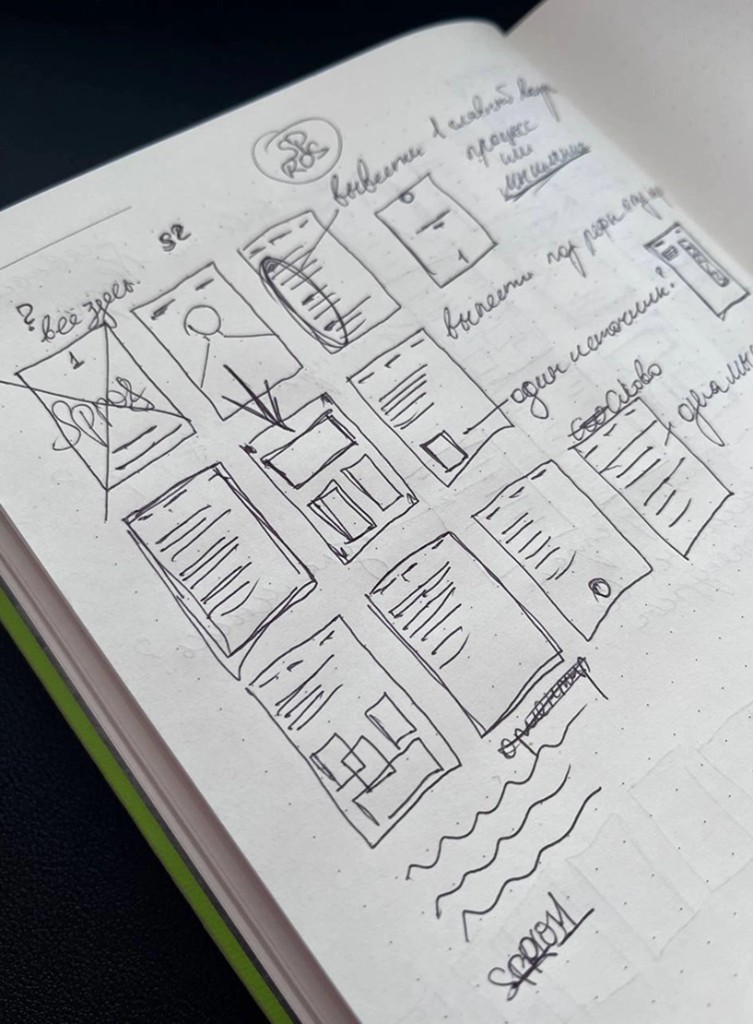
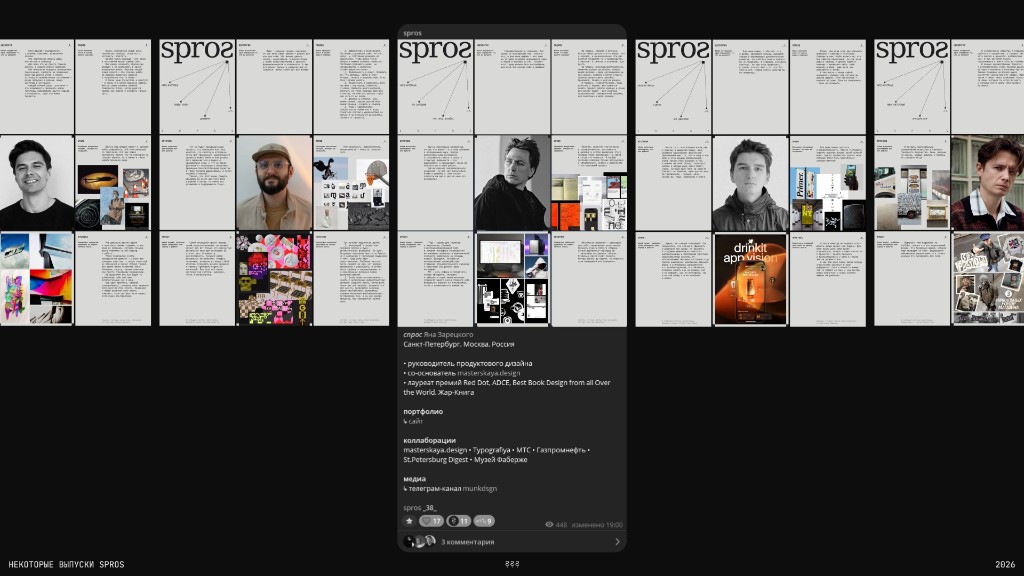
The project's concept is as follows. Spros is text card-interviews with those who shape the visual context of our environment: designers, artists, visionaries and various creators. It's a Telegram project built around the concept of "spros" (Russian for "demand" – also a play on "asking") and includes several formats (for example, the studio spros, the art directors' spros, the spros on practice and many other formats described in the channel). At the same time, the core of the project remains the classic issues with designers, made of 9 cards and links to the guest's main resources: every such issue has the same questions on six topics:
_1_ Ideology
What inner idea defines what you do?
_2_ Approach
What principles underlie your approach?
_3_ Source
What sources inspire you outside of work?
_4_ Archive
Recent visual finds that you've saved.
_5_ Project
Which project most fully reveals your approach to work?
_6_ Practice
Share a small practice from your personal experience.
When developing the concept in more detail and choosing the topics, I of course had various options for both the topics and the questions themselves. In choosing, I wanted not just to collect a pool of interesting questions but to build a certain logic and structure of conversation. An issue starts with ideology and approach, because they help understand how a person looks at the profession and what principles underlie their decisions. Then come sources and archive – topics that let you see what their visual and cultural field is made of, what influences their thinking and attention. After that comes the project, as the result of all the previous layers, a chance to see how ideas and principles show up in real work. And the issue ends with practice – the most applied and human level of the conversation.
Probably, if you look at this structure as a whole, it moves from the inner to the outer: from beliefs and thinking to influences, then to the results of work and, finally, to everyday practice. I wanted to create a format that helps see not only what a designer does, but how they get there.
Now I'll say a little about why spros appeared at all
I've been doing design for about 5 years, and in that time I've subscribed on various platforms to many talented professionals. All this time, watching them, I mostly saw their projects, cases, awards and professional achievements. But I knew almost nothing about how these people think, what principles underlie their work, what inspires them and what practices help them grow.
Most designers are fairly non-public people. They just do their work well and rarely talk about themselves beyond projects. Of course, there are specialists who actively speak at conferences, go on podcasts, teach and run social media. But a huge number of strong designers and art directors remain in the shadows, showing the world only the results of their work.
It was this observation that largely pushed me to create spros. I wanted to look a bit deeper than projects and understand who the people behind them are, how they make decisions, what they rely on in their work and how their professional outlook was formed.
By the way, there's quite concrete confirmation of my words. After taking part in spros, some designers and art directors with 10–15 years of experience wrote to me that it was their first interview in their entire time in the profession. And there turned out to be many more such cases than I expected.
So I can say that spros was born from a simple and sincere interest in getting to know professionals in their field a little better and sharing that knowledge with the design community.
Why I chose a text interview format
Personally, for me a text interview remains a more intimate story, where the guest has enough time to reflect on the answer. Today most content exists as video and podcasts, but text still remains one of the best tools for capturing and conveying thought. It requires more concentration from both the author and the reader, leaves room for interpretation and lets you return to individual ideas after some time.
Besides, text creates more even conditions for conversation. Charisma, voice, recording quality and other factors that can distract from the content recede into the background. What stays at the center are the interlocutor's own thoughts, experience and wording. And for a project that explores design culture through ideas, principles and values, this seems especially important.
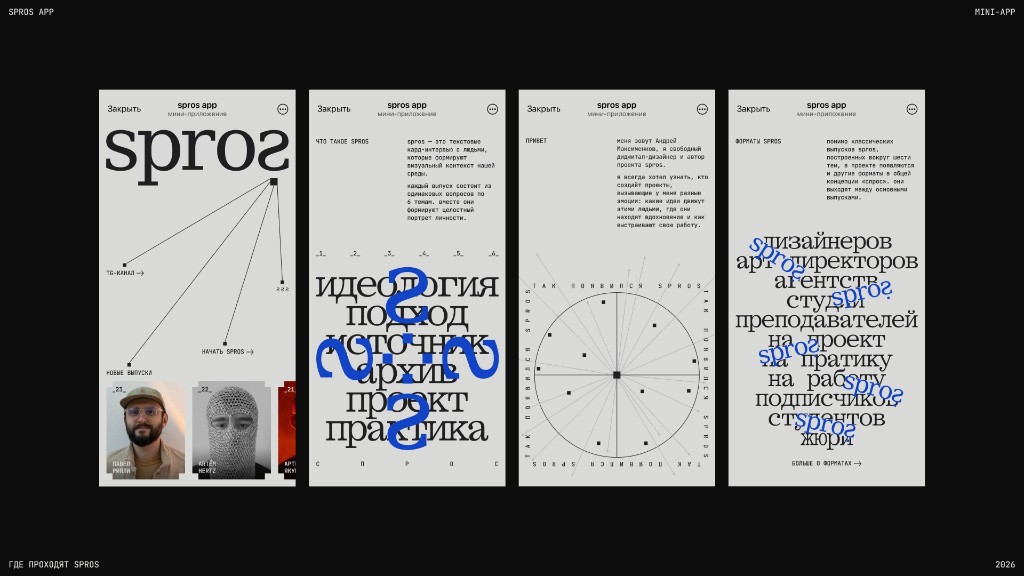
Each guest goes through the "spros" in a special mini-app, spros app, inside Telegram, where the questions on all six topics of the project are collected as a questionnaire – the guest answers at their own pace, and I put together the issue from the answers received. That way all interaction happens within a single communication environment, and only invited guests have access to the questionnaire.
Wrapping up this speech, I'd like to answer the last part of the question – "what is most valuable to you in the project?"
I see the value of spros for me in the fact that I have a chance to record and preserve professional experience that usually stays invisible. While working on the project I understood that design is much more interesting to look at not through individual artifacts but through people and their ways of thinking.
From issue to issue you can notice which sources of inspiration repeat, which working methods turn out to be close to many, which ideas shape our generation: a sense of a shared culture, values and principles that unite this community emerges.
I think that's exactly where the main value of spros lies for me – not just telling the stories of individual designers, but through them better understanding the state and development of design culture as a whole. After all, the more we talk about how we think, make decisions and work, the more conscious and mature the professional community becomes.
Craft and technology (AI) – do you see a conflict between these concepts, or do they reinforce each other?
Honestly, I don't see much conflict between these concepts, because they exist at entirely different levels of work. Neural nets help do tasks faster and more efficiently, while craft determines the quality of the decisions behind that work. AI can help with finding ideas, research, picking refs, but it can't replace taste, a trained eye, an understanding of context and the ability to make conscious decisions. But that may be "for now," let's follow how things develop.
Moreover, I think that as neural nets develop, the value of real craft only grows. When the technical barrier to entry gets lower, the qualities I wrote about a bit above become more and more important. That is, precisely those qualities that can't be reduced to pressing a single button.
So for me AI is not an alternative to craft but one more tool. I think this idea is super simple. The question isn't whether you use this tool or not, but what decisions you make with its help and what meanings stand behind them.