
Appropriate design, "Typomania," Werkstatt, and the limits of the term "design culture"
How do you define design culture for yourself? Principles, values, rituals within a team, readiness to take responsibility?
Given the context we're all in, where nothing is outside politics and the political is personal, design and work too – it's all your human position. A lot comes through there: principles, values, your view of life – it shows. And you act depending on the situation you're in, and these are super different situations – some people have the resources and the freedom to follow principled decisions, for example, not to work with tobacco companies, and some don't, because we live under capitalism and you can't live without money.
This is an inner story, and because we're in a harsh context, you have to think about it. There are people who don't think about it, and there's nothing you can do about them. And there are those who think about it so much that they stop being a designer and become a lawyer, because a designer can't do anything.
I don't have an answer. There's no right answer, everyone has their own. And there's beauty in that. It's more important to be a good person than a good designer.
I don't have an answer. There's no right answer, everyone has their own. And there's beauty in that. I think it's more important to be a good person than a good designer.
– Yulya Kondratyeva
Some people think about it so much that they stop being a designer and become a lawyer, because a designer can't do anything.
– Yulya Kondratyeva
Where's the line between the person and design? How did design come into your life at all? Through what key points did your focus change?
My path was unconscious. At school I went to draw almost all the time – these were extra classes, not art school. At some point the daughter of some family friends started going to draw with a particular artist, a magnificent painter who still paints brilliantly. They sent me there too. This artist had studied in the sixties at Poligraf – the Moscow University of Printing Arts, now Polytech. The people she saw potential in, she sent to apply to Poligraf and gave them the contacts of teachers.
At school nothing much interested me except anime. I thought: well, okay, I'll be an illustrator, because I didn't know about printing and publishing, only that they draw books there. I got in.
On the very first of September it turned out there was such a thing as graphic design. At Poligraf there are several departments: illustration, graphic design, type, easel painting. For the first three years you study the same things everywhere, then you choose a specialization. Over those three years it became clear that I'm not an illustrator at all, I'm a designer. A lot of that is thanks to my parents, who paid for the first three years.
I didn't move on to the next year, because teachers change from year to year and lead a group somewhere. I ended up with Alexander Andreevich Vasin, his brother Ivan Andreevich Vasin, and Natalia Evgenievna Luchinskaya. Very cool designers and teachers. Ivan Vasin – Shchuka – taught for a couple of years, then went into business. Alexander is a very cool teacher, a good designer; resourceful, but not a genius, I think. Just a good designer. I'm also just a good designer. Nothing special.
But he's a great teacher. He always has ideas. In the second year he said: "Oh! I want a festival! Girls, want to help?" A small group of us took the initiative and agreed. That's how the "Typomania" festival came about.
What's the school's approach? You run six to eight courses, and it seems to me you have a pretty strong approach.
There's a business part. And at the same time some kind of approach.
Designers can't talk at all. So we decided we needed a course on presenting. We went to Sonya Stupennikova ourselves, we knew she did this, and we made the course with her and Anya Dobranskaya.
With Maxim we wrote a course on qualitative research, because Maxim is wonderful, and it's a very interesting, non-obvious topic. I believe design is about people. If you want to do something properly, you have to do it for people. And the interview method is exactly about people. You can learn a lot if you talk to people.
That's how we slowly develop the courses. Right now we're also tinkering with something with different people at different stages of readiness.
Designers can't talk at all. So we decided we needed a course on presenting.
– Yulya Kondratyeva
What is good design? Can it be defined somehow, or is it a very situational thing?
That's a hard question, which is why I stopped dealing with it.
Good design is appropriate design. It depends a lot on context, on what you want to say to someone. Design is, in large part, not self-expression. Most often there's a second party you're doing something for, that party has its own goals, and you can't express yourself there. To some extent your vision, your techniques, your optics slip through. And of course everyone has at least a sequence of steps that one way or another leads to a similar result; trying to do it differently is often a challenge for a designer.
So I have no idea what good design is. It's appropriate design. At the same time, of course, I like some things, I like this one, but usually I like it without context. I look at Chinese posters, I have no idea what's written there. Beautiful. What is it? Is it appropriate? I have no idea. It's beautiful design.
I don't get into that, I'm not very interested. At the same time, of course, I get quite upset. Just now people around me posted the shortlists, and it's utter gloom. I didn't understand anything. Clearly there are a few fresh names and ideas, but mostly it's average, not especially convincing, similar to each other. And yet who would say it's inappropriate? It's appropriate. I wonder how the jury measures quality. I don't know.
Good design is appropriate design. It depends a lot on context, on what you want to say to someone.
– Yulya Kondratyeva
I look at Chinese posters, I have no idea what's written there. Beautiful. What is it? Is it appropriate? I have no idea. It's beautiful design.
– Yulya Kondratyeva
Maybe you could recommend a book? I'll remind you of the library and the school.
Something pleasant, good, in words... I thought about the books from the library, but apparently that's not what the question is about.
There were four hundred books there. Some were design literature, some were catalogs, some were something else. There weren't that many gems, but a quarter of the whole volume was cool books. And magazines.
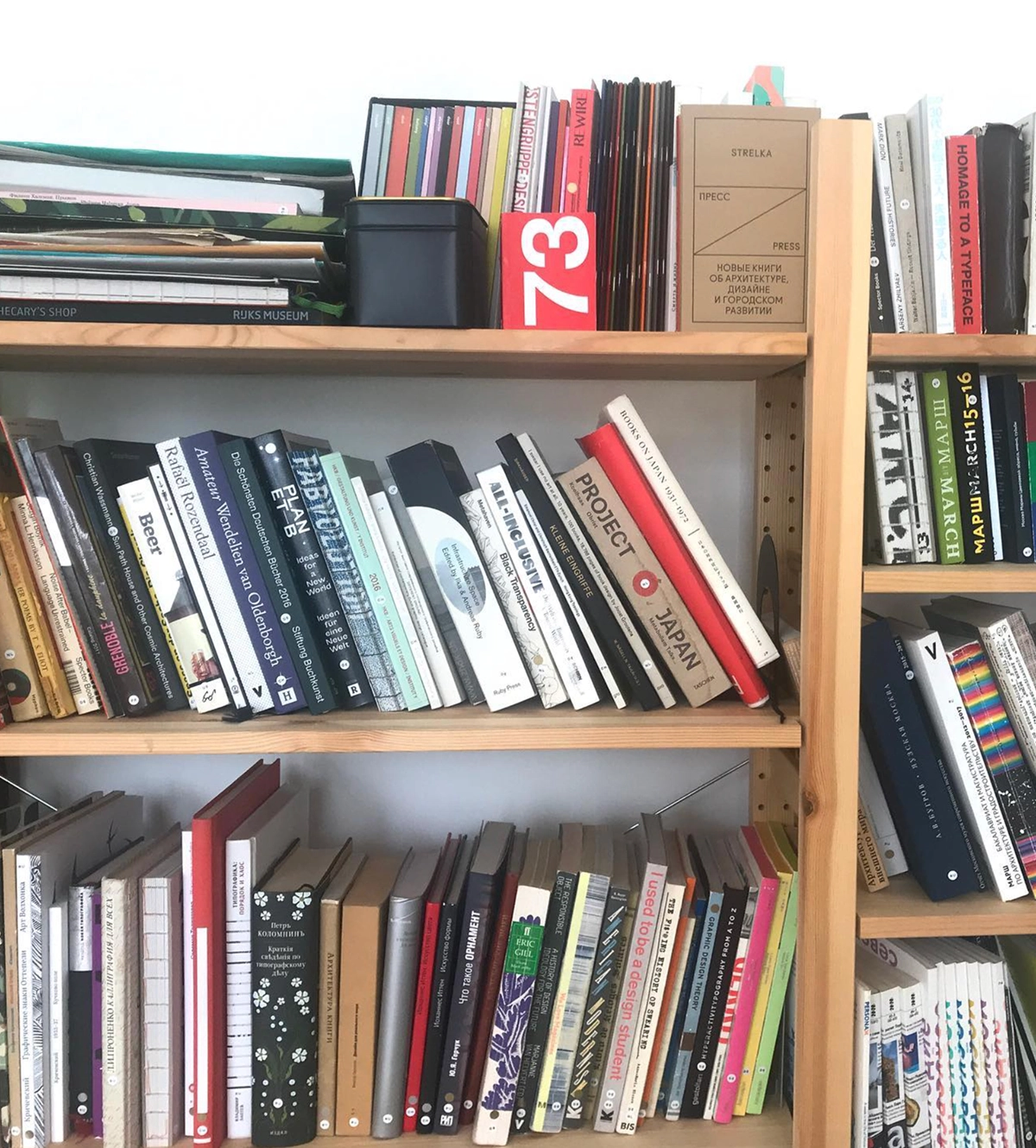
I took my favorites with me when I left. One I couldn't find, and I want to find it in Moscow. It's the catalog of the best books of the Swiss design competition for 2016. Made by the Design studio. The point is that it's a genre of book catalogs: every book competition has a catalog. Book competitions exist in every country: Switzerland, Germany, the Netherlands, Russia. They all make catalogs. It's a genre that's similar in form. The challenge for a designer is to make something original.
And this particular catalog was original in that the designers decided to break the books down into elements and look at them separately. They scanned all the binding materials and compared them: thirty best books, what materials they have, what kind of black, what covering. They looked at color, halftone, fonts, margins. They pulled out about sixty parameters and compared them under a microscope.
From these elements, laid out one after another, you can't get an overall impression of a book. You see separate elements. But the point is that these books are the best partly because these specific elements are the way they are. And it's very striking. The idea is cool, the presentation is superb, beautiful, and the design studio is superb. An excellent book. I love it. A pity I couldn't find it and bring it.
And the first thing I thought of: we had two Soviet books, "Encyclopedia for Men" and "Encyclopedia for Women." Those were good times.